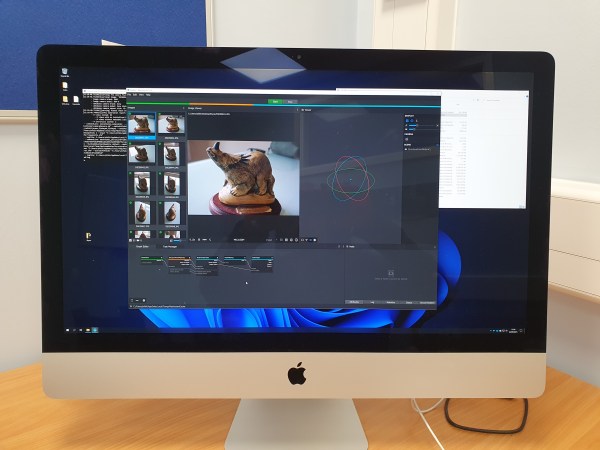
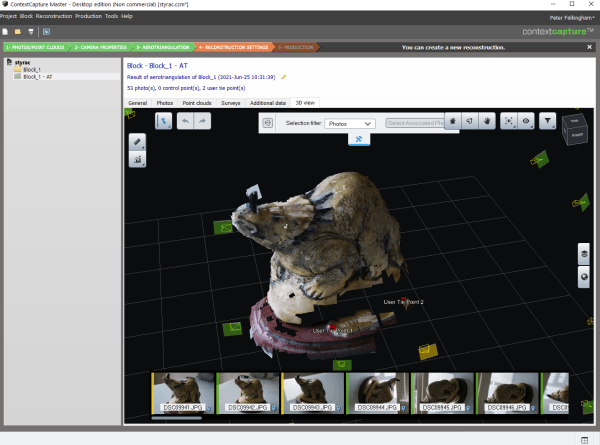
I’ve covered 3DF Zephyr before, both the free version, and the professional version. Today 3D Flow released version 5.0, which claims significant speed ups and quality improvements, so I thought I’d run my standard dataset through it. I'm using the 14 day trial version of Lite. The free version is still available but limited to... Continue Reading →
Moving from Endnote to Zotero
A running theme of this blog (and my work in general) is in using freely available software when I can. There's multiple reasons for this; the main and most obvious being saving money. But there are other reasons too - losing access when changing institutions (or when licensing changes and something becomes unaffordable) is a... Continue Reading →
Transferring textures from two halves to a whole (using Maya)
Retexturing from two seperate scans using Maya.
Transferring textures from two halves to a whole (using Blender)
Using a scan in two halves to re-project a texture onto a new mesh, using Blender.
Aligning and merging two halves of a scan: CloudCompare
This post will show you how to align a scan in two or more parts using CloudCompare. Or there's a video tutorial. Ideally, when you scan an object with laser scanning or photogrammetry, you want to get the whole thing in one go. With photogrammetry, that might involve what I've seen called the 'void' method... Continue Reading →
Alicevision Meshroom 2019.2.0 – best settings (that I use)
I covered Meshroom back when it was version 2018. Shortly after, I wrote about trying out all the settings. It's been over a year and half since then, and in that time Meshroom has become my default photogrammetry software. I've got into a habit with changing the default graph, so wanted to share the settings... Continue Reading →
Photogrammetry testing: Regard 3D
You can find links to all my other tests/guides here. Regard 3D has been around for a while now. I included it in my 2017 photogrammetry roundup, and version 1.0.0 was released in march 2019, but I’ve never actually run through it on my blog, so here goes. Regard 3D uses openMVG as the backend... Continue Reading →
Photogrammetry testing: OpenDroneMap
Testing WebODM - OpenDroneMap photogrammetry software.
Creating a flexible height ramp shader for blender
A custom shader in blender for quickly applying height maps to fossil tracks.
Use the Xbox Game Bar in Windows 10 to record tutorials
In these days of working from home, you may need to explain how to do something visually on you computer. Windows 10 has a built in screen recorder in the Xbox Game Bar, and I've been using this to record short tutorials for this website, and for students accessing information for the first time online.... Continue Reading →