I should probably have made this post sooner, as it's about my chapter in the Great Dinosaur Track Book Of 2016: "Dinosaur Tracks: The Next Steps". It's a volume I was privileged enough to be an editor for, and it contains a number of excellent chapters. I wanted to post about my own... Continue Reading →
Photogrammetry Testing 4: OpenMVG and MVE (+TexRecon)
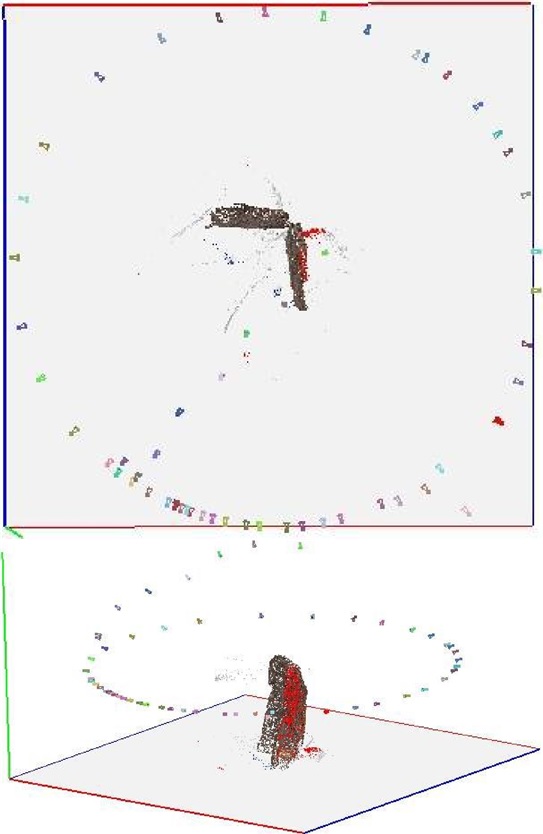
Here's the original post, and links to all posts I have previously outlined my goal of testing multiple photogrammetry solutions on a single dataset, and reporting times and results. I'm using a dataset based on photographs of this Styracosaurus model (I've had it since I was quite young): The dataset has 53 photos in total,... Continue Reading →
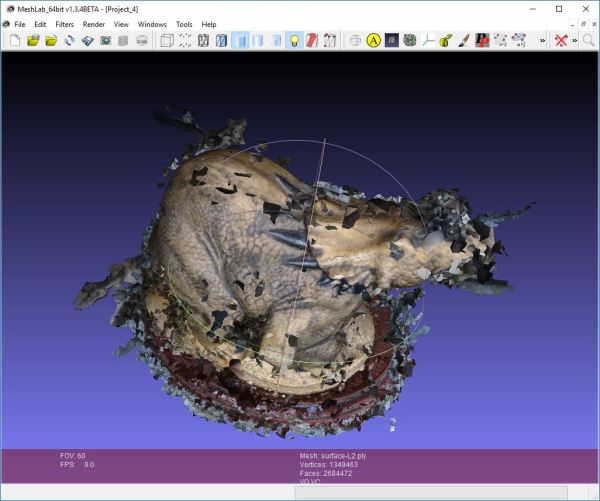
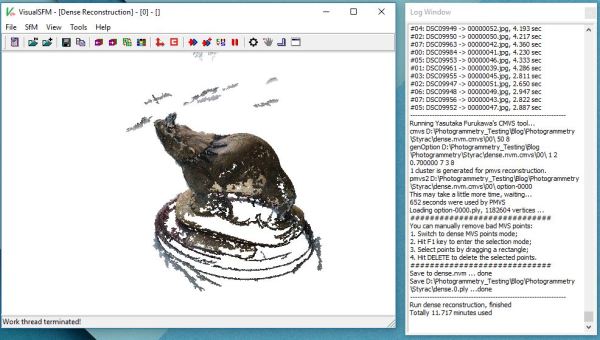
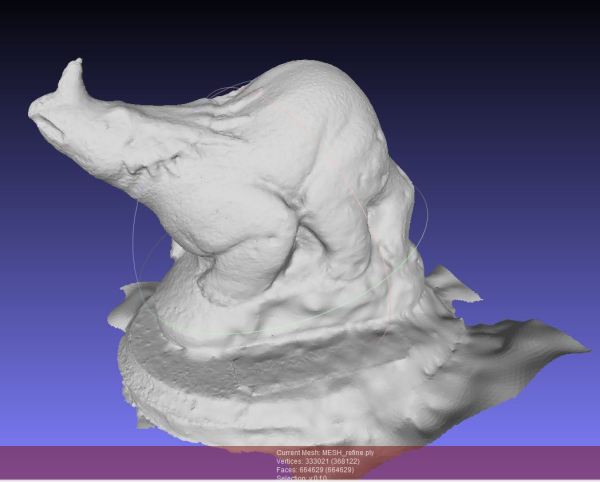
Photogrammetry Testing 3: VisualSFM + PMVS + Meshlab
Here's the original post, and links to all posts I have previously outlined my goal of testing multiple photogrammetry solutions on a single dataset, and reporting times and results. I'm using a dataset based on photographs of this Styracosaurus model (I've had it since I was quite young): The dataset has 53 photos in total,... Continue Reading →
Photogrammetry Testing 2: VisualSFM and MeshRecon
Here's the original post, and links to all posts I have previously outlined my goal of testing multiple photogrammetry solutions on a single dataset, and reporting times and results. I'm using a dataset based on photographs of this Styracosaurus model (I've had it since I was quite young): The dataset has 53 photos in total,... Continue Reading →
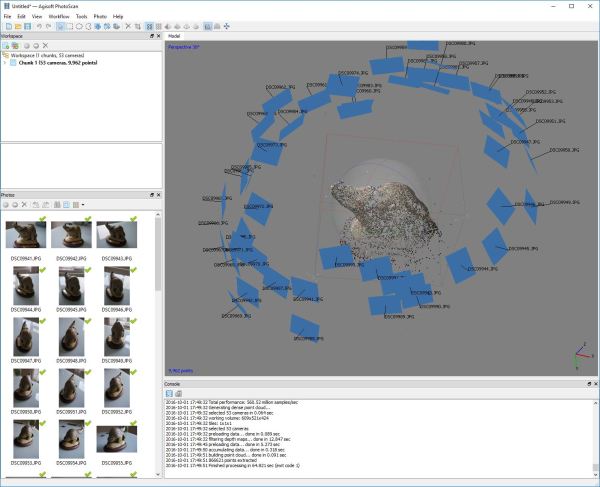
Photogrammetry Testing 1: Agisoft Photoscan
Here's the original post, and links to all posts I have previously outlined my goal of testing multiple photogrammetry solutions on a single dataset, and reporting times and results. I'm using a dataset based on photographs of this Styracosaurus model (I've had it since I was quite young): The dataset has 53 photos in total,... Continue Reading →
Trying all the free Photogrammetry!
In which I tried - and failed - to document pros and cons for about a million different combinations of software.
Getting OpenMVG set up on Bash for Windows
OpenMVG is a pipeline for structure from motion. I’ll go through the basics of downloading, installing, and running it on Windows 10. It does actually compile on Windows, but it can be a royal pain in the rear to get everything set up properly (requiring Visual Studio, Python, and a lot of luck). Far... Continue Reading →
Generating a Photogrammetric model with MeshRecon
Continuing my series of using photogrammetry software, we come to MeshRecon, by Zhuoliang Kang. This is one of my favourite photogrammetry pipelines, and it's dead easy to use: Download the Zip file from Kang's Webpage here: http://zhuoliang.me/meshrecon.html Unzip the folder somewhere, and inside are 4 sub-folders (img, meshrecon, results, and vsfm), a readme, and a... Continue Reading →
Generating a Photogrammetric model using VisualSFM, and post-processing with Meshlab
This is a re-post of a document I placed on Academia.edu a few years ago. In fact, that academia paper has sat in Academia.edu's top 0.5% of papers in terms of views for some time. However, I'm reposting for two reasons: 1. Academia.edu have added so many 'premium' (i.e. costly) features that I'd like it... Continue Reading →
Quick ‘n’ Dirty guide for making photogrammetric models with Agisoft Photoscan
Ok, this isn’t really necessary, but I’m posting it for completeness sake as part of an upcoming blog post. This will just give you a quick rundown on how wiz through Agisoft’s Photoscan and generate a model. If you’d like a more in-depth piece, I suggest Heinrich Mallison and Oliver Wing’s paper in Journal of... Continue Reading →