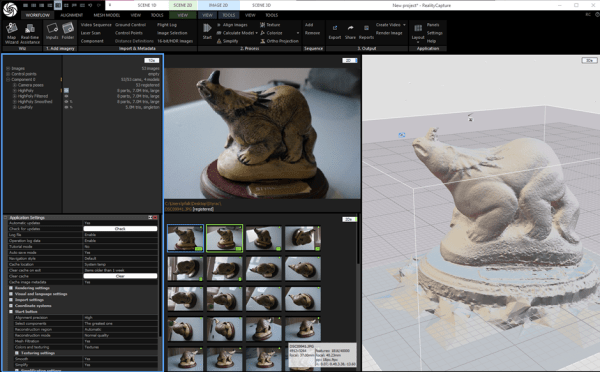
As I’d previously noted, RealityCapture has been re-branded to RealityScan, to align branding across desktop and mobile applications. With the rebrand come some major new changes: AI Masking Smarter Alignment Aeriel LiDAR Support Quality Analysis To install it, you need to fire up Epic Games Launcher, then I had to wait a while until the... Continue Reading →
No more Agisoft? Turn to Reality Capture with this guide
I’ve had multiple emails now from different people working at US government agencies – Agisoft Metashape is no longer available nor allowed because it’s made by a Russian company. Below, I’ll provide a run through of Reality Capture as it stands today. The main competitor to Metashape is Reality Capture, now owned by Epic Games. ... Continue Reading →
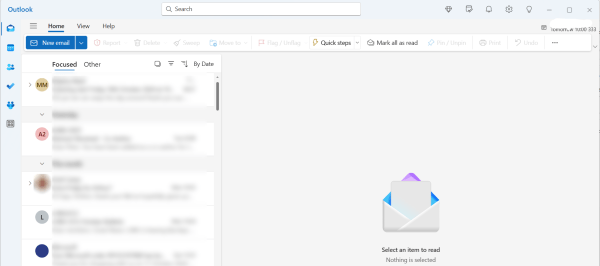
‘[New] Outlook’ – everything that’s wrong with modern software
[FYI - This post is mainly just for me to keep track of my venting] The time has finally come - Mail and Calendar, my favourite email application in a long time, has now been completely replaced by 'new' Outlook, and my attempts to revert are met by an instant reinstallation of the naff new... Continue Reading →
Dabbling with Linux again. And quickly giving up… again.
I tried installing linux again. Got frustrated, went back to windows.
Focus stacking and photogrammetry
I experimented with macro photogrammetry using a small fossil and a Nikon Z8 camera with MC105 VR S lens. I used focus-shift and focus-stack with shallow depth of field. Reality Capture produced a good model from the focus-stacked images, but using the lens at f51 also yielded a great result. Both methods have their benefits.
An Excellent Free and Open Source focus-stacking solution
I struggled with merging focus-shifted images using Photoshop and Affinity Photo but found success with Helicon Focus, though with some limitations. I then discovered focus-stack on GitHub, a simple command-line tool, which was comparable to Helicon Focus.
My experience training a local LLM (AI chatbot) on local data…
The user encountered challenges while attempting to use various methods to feed information into local Large Language Models (LLMs) via RAG (Retrieval-Augmented Generation). They explored methods such as Nvidia Chat with RTX, Ollama with Python scripts, and Ollama with Open-webui. Results varied, with some methods providing inaccurate or incomplete outputs. Comparatively, Microsoft Co-pilot, running GPT4-Turbo, significantly outperformed the local methods.
Reality Capture going free for everyone*
The other day, I saw that Capturing reality announced a new pricing plan for their photogrammetry software Reality Capture: https://twitter.com/peterfalkingham/status/1767573164614103112?s=20 Reality Captured wormed it's way into my heart as my favourite photogrammetry software. Initially, while I was blown away by the speed of Reality Capture, I had a bit of a rough first impression due... Continue Reading →
Beholder Vision Desktop
I reviewed Beholder Vision back in 2022, and then it was a web-based service, where you upload your photos, it produces a model, and you then download it. That service is still available, but Beholder have now released a desktop version. Best of all, it’s complete free for personal use. It’s technically ad-supported, though so... Continue Reading →
RealityScan – Photogrammetry on Android
As with so much of my gadget life, I've been looking longingly over at the Apple ecosystem, in this context specifically for the amazing 3D scanning apps that are available for the iPhone and iPad. Because those devices have lidar on the back, 3D scanning apps work really well - using the camera to texture... Continue Reading →