I'm featured on May's Palaeocast. Go have a listen.
News/Blog
(This guide was actually written 25/5/13, but should still be applicable. PDF here) This guide will hopefully provide a quick start to processing CT data and exporting models using 3D slicer (http://download.slicer.org/). The documentation available for Slicer is pretty fragmented and/or out of date (referring to considerably older versions), so this guide is based on... Continue Reading →
A rough guide to getting models out of CT scans using 3D Slicer (v4)
The Historical Photogrammetry Challenge – over to you!

In 2014, colleagues and I published a photogrammetric reconstruction of the Paluxy River dinosaur ‘chase sequence,’ as generated from photographs taken before and during its excavation in 1940. (Blog post here). Photogrammetry has become pretty common now; commercial and open source programs are widely being used by all kinds of people, including palaeontologists, and there are... Continue Reading →
Weighing Dinosaurs (and other animals) with Meshlab

A couple of years ago, I was part of a group that published a method on calculating body mass in extinct animals from laser scans of their skeletons. The method involves separating the model into parts, and then using the qhull command to produce a volume that encloses the segment as tightly as possible. This... Continue Reading →
I love it when a plan comes together
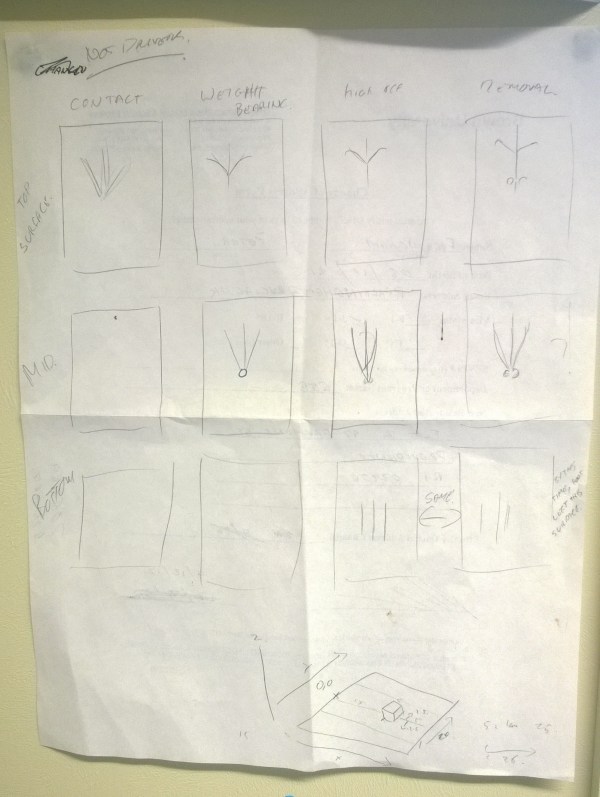
I was clearing out some papers from my desk draw, and came across this: This is an initial idea Steve and I sketched, one day in mid 2012, of how we thought some of the Amherst tracks were being formed. Ultimately, those first discussions lead to this figure in our recent paper: It's nice to see... Continue Reading →
The birth of a dinosaur footprint

Monday saw the release of a paper that Steve Gatesy and I have been brewing up for the past couple of years. The paper is published in PNAS, and is titled: The birth of a dinosaur footprint: Subsurface 3D motion reconstruction and discrete element simulation reveal track ontogeny. It's a bit of a long title,... Continue Reading →
Stop being so picky, Goldilocks
[This post is about a new paper available freely here] In 2012* with colleagues at Manchester we published a paper entitled ‘The 'Goldilocks' effect : preservation bias in vertebrate track assemblages.’ If I were to give you a simple one-liner for the paper, it would completely undermine the effort went into the paper… that if... Continue Reading →
SVP teaser/Playing with renders
I've been trying to jazz up my talk for the Society of Vertebrate Palaeontology conference in Berlin next week, and also been using the opportunity to play with Maya's rendering abilities (and also avoiding writing a lecture!). So, you might expect to see a longer, more polished version of this at my talk at SVP:... Continue Reading →
New tracks added
Very short post to announce there's a couple of tracks added to the resources section - one modern (A deer track), and one fossil (A dinosaur track from Whitby). More complete blog posts to follow soon.
Not Just Pretty Pictures…
Digitization is no longer just a novelty – it is absolutely vital to good analysis and communication of data, and it’s so easy more people should be using it. Most people reading this blog will probably know what photogrammetry is, and it’s not my aim here to discuss the method per se. Suffice to say... Continue Reading →
 Prof. Peter L. Falkingham