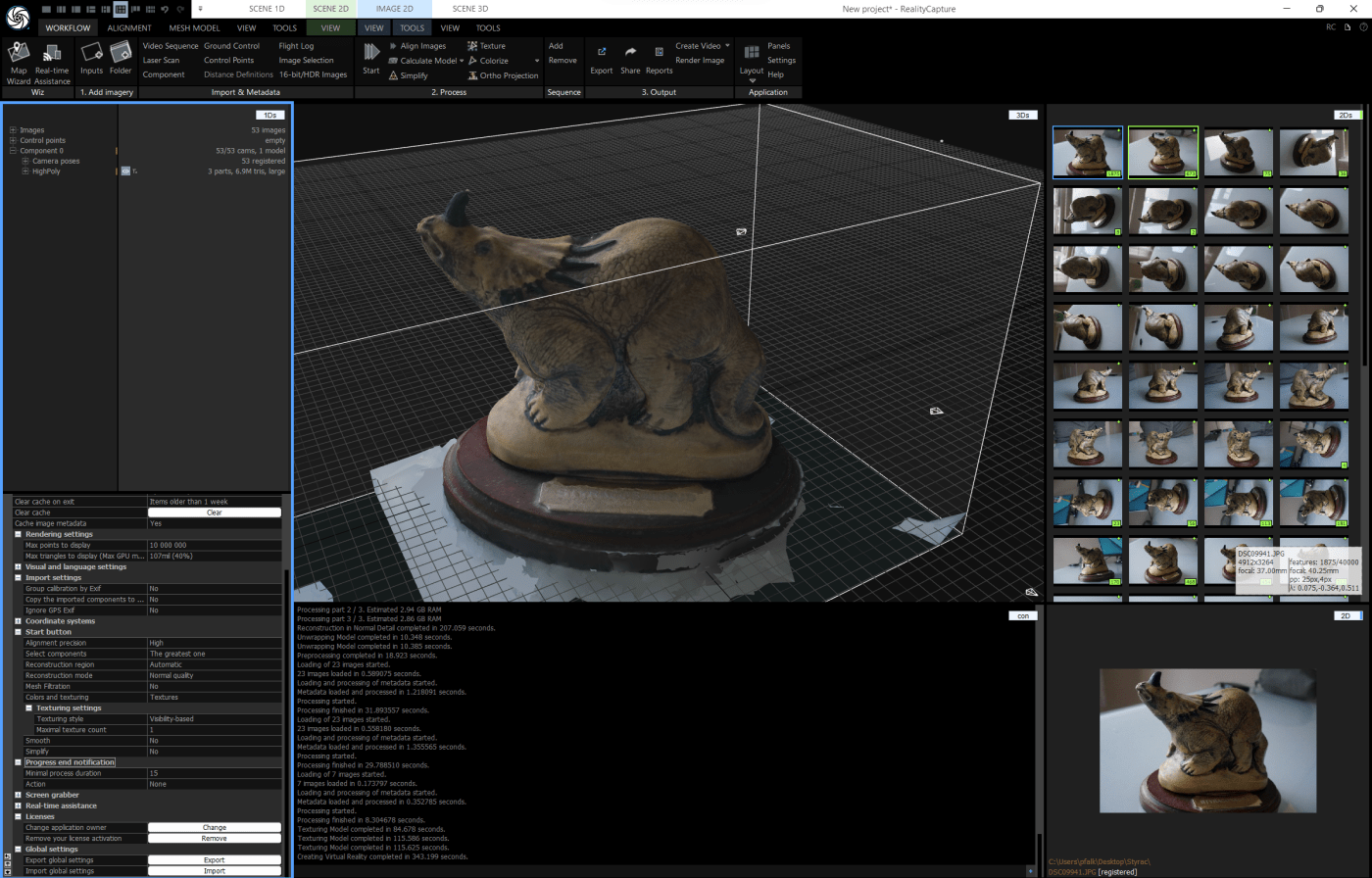
Yesterday Capturing Reality released Reality Capture 1.3. Key among the change log was “faster model reconstruction and texturing”, as well as some improved UV unwrapping.
I’ve enjoyed the speed of Reality Capture for a while, and last year declared myself a reality capture convert. In fact, I now use Reality Capture as a matter of course for everything, unless I need to run a quick model on my work iMac (which is now out of support and will hopefully be replaced this year), and recommmend to colleagues that unless they are stuck with MacOS and no Nvidia card, Reality capture is the way to go.
There’s not a lot to show you with this release, the interface still looks identical, and still suffers a little from the odd way settings menus appear in the lower left, then sometimes hang around and sometimes dissapear.
It’s also hard for me to directly compare speeds, because I’ve gone through several upgrades since I last tested my default dataset, including the shift away from a home desktop to my Surface Laptop Studio, and eGPU (I’ll do a long term review soon of the SLS, which has it’s downsides, but has been an absolute belter of a device).
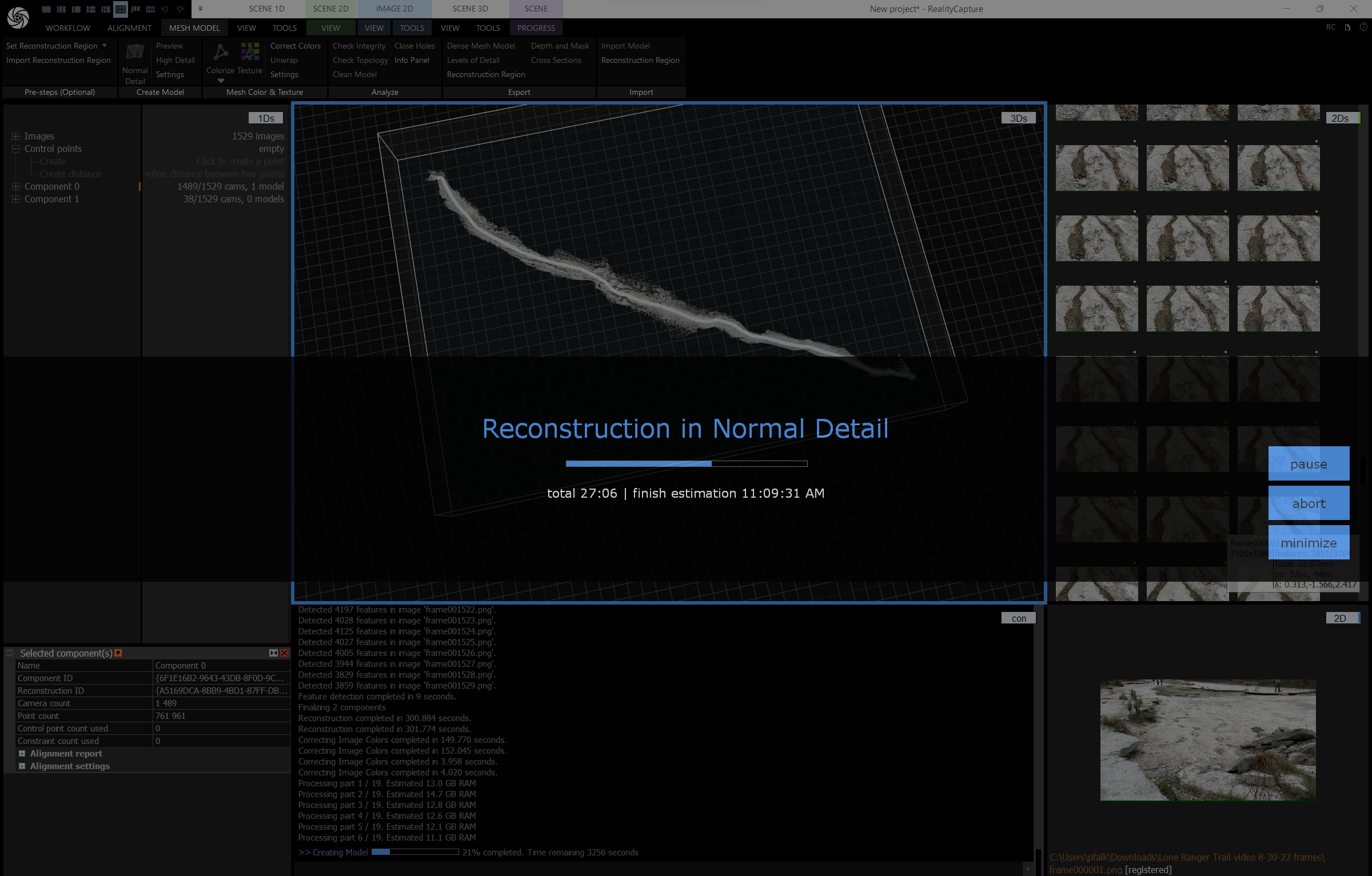
But, for reference, I ran my standard 53-image dataset through Reality Capture, by just hitting ‘start’ and using default settings (I reset everything to default before hand). It took just 9 seconds to align all the images and create a sparse point cloud. The total process took a little over 6 minutes, which is pretty much what it was when I first tested Reality Capture back in 2017.
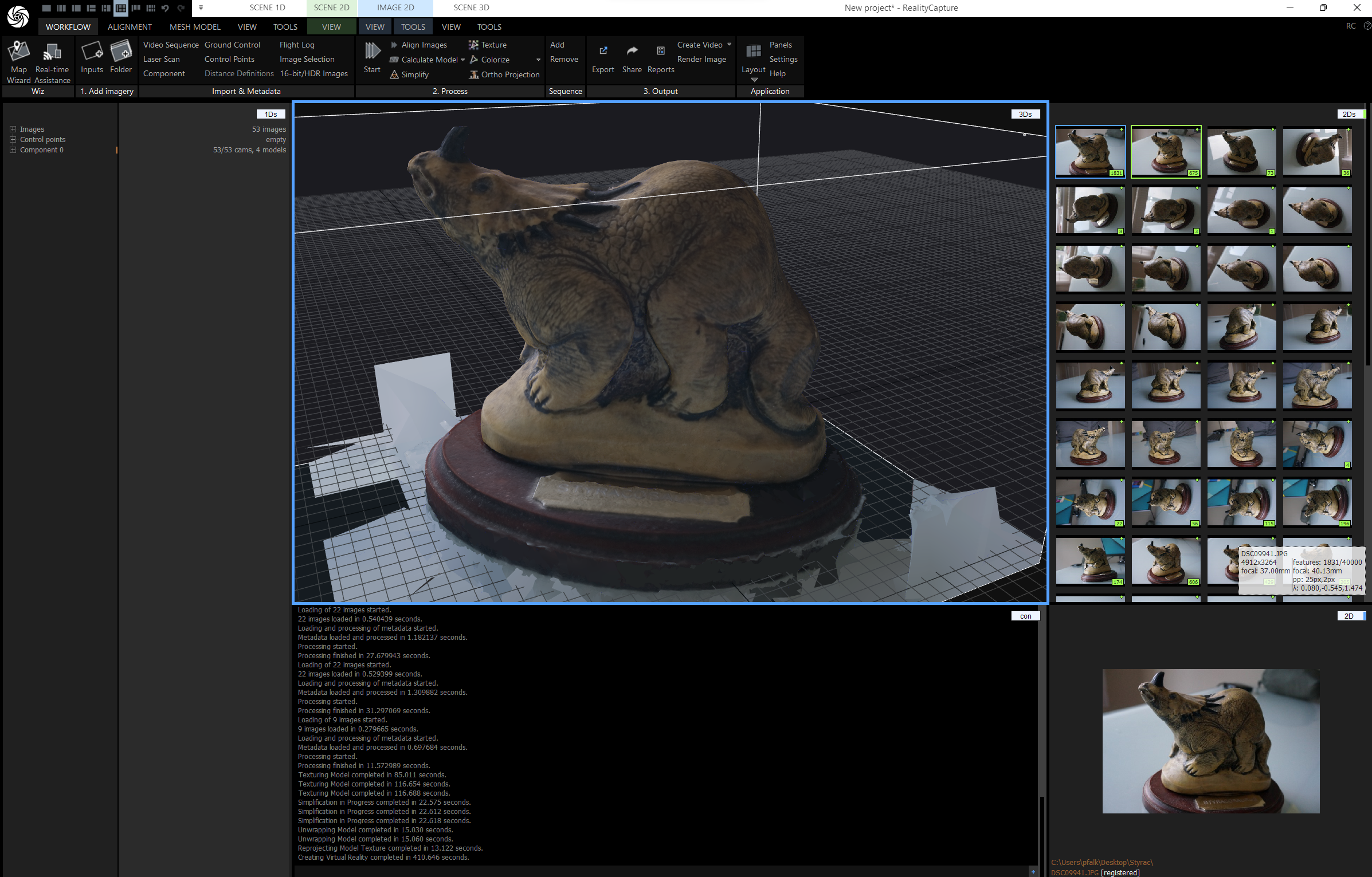
However, the model was nicer than back then (the horn is a little clearer), and I realised that the ‘start’ button produced several meshes – an original, a smoothed, a filtered, and a low-poly (capped at 5 million polygons):
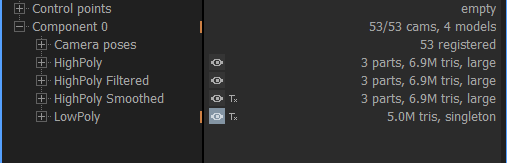
With those bits off, it took 5 minutes and 43 seconds from start to finish, and the final mdoel looked super:
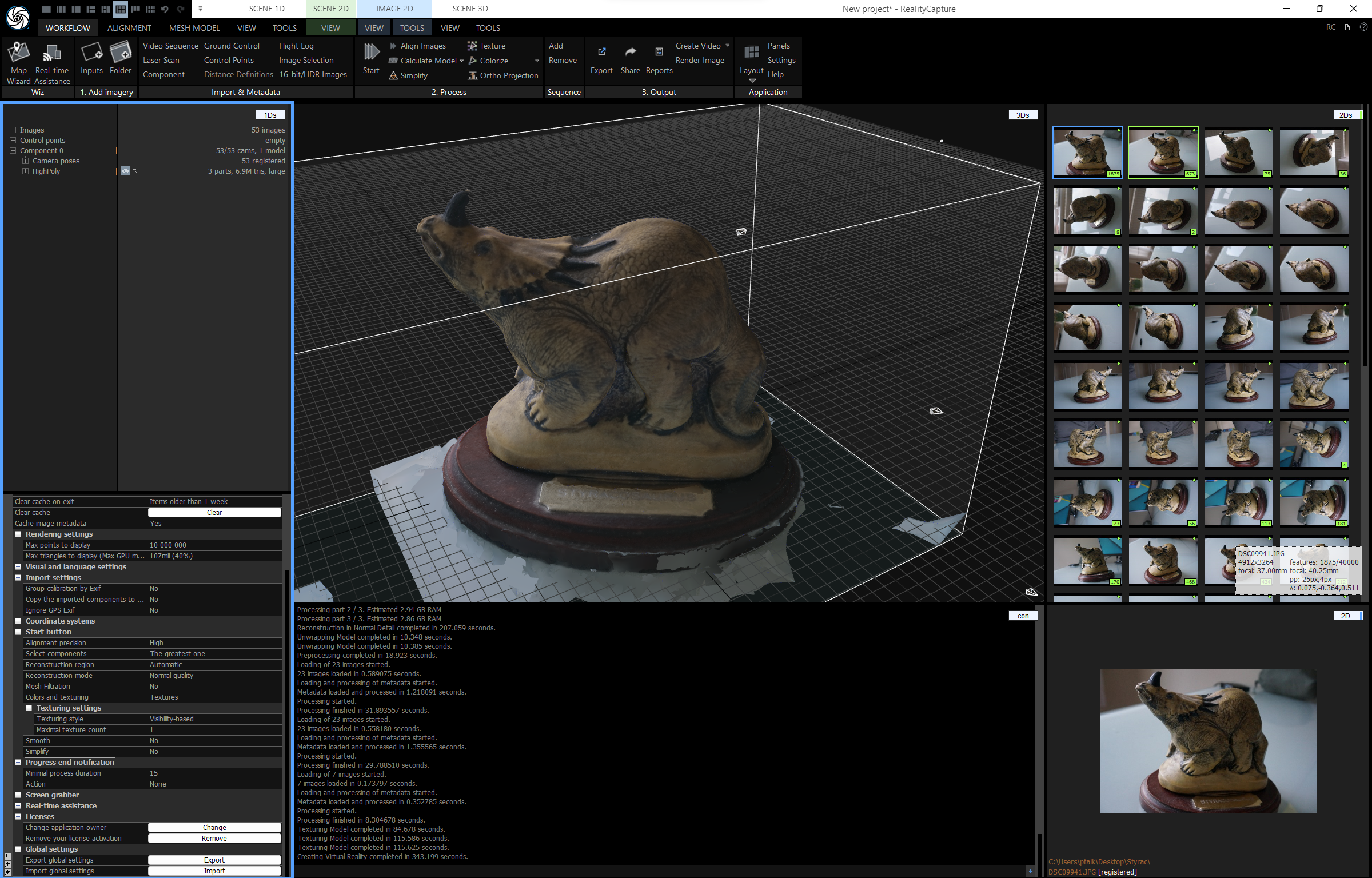
It’s not exactly much of a speed boost on this dataset, but my understanding is that the real speed savings come as datasets get larger. Unfortunately, I don’t have the time right now to do a bunch of 30 minute/1hr tests.
Still, this is clearly the software to beat, especially as an academic email address will get you it for free.
 Prof. Peter L. Falkingham