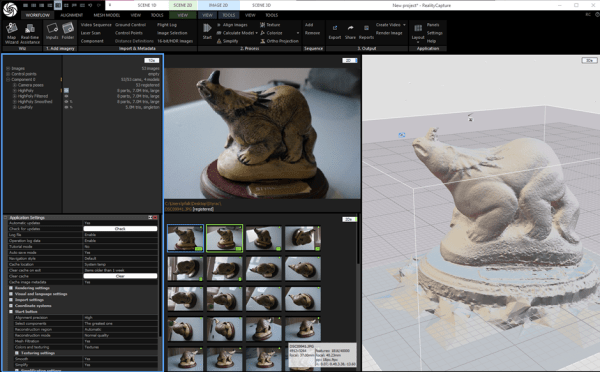
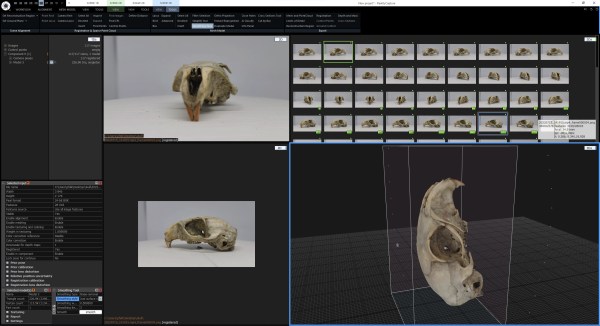
I’ve had multiple emails now from different people working at US government agencies – Agisoft Metashape is no longer available nor allowed because it’s made by a Russian company. Below, I’ll provide a run through of Reality Capture as it stands today. The main competitor to Metashape is Reality Capture, now owned by Epic Games. ... Continue Reading →
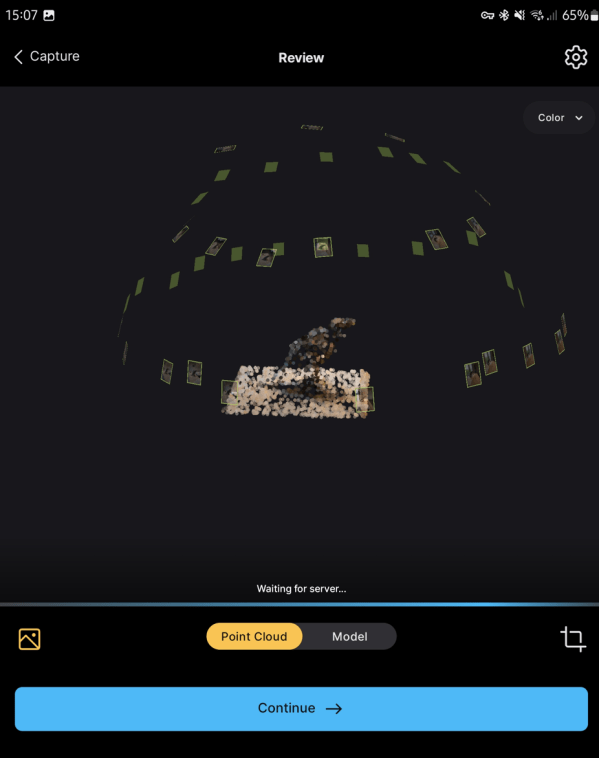
RealityScan – Photogrammetry on Android
As with so much of my gadget life, I've been looking longingly over at the Apple ecosystem, in this context specifically for the amazing 3D scanning apps that are available for the iPhone and iPad. Because those devices have lidar on the back, 3D scanning apps work really well - using the camera to texture... Continue Reading →
Updated height map material for blender – use images or colour ramps
Recently for our paper on hominid tracks, I was visualizing some topographic images of footprints using blender. We were asked by the journal not to use the standard red-green-blue colour scale as it's not great either for colour blind people, or for conveying subtle changes in topography. Rather than use black-white, as I've done in... Continue Reading →
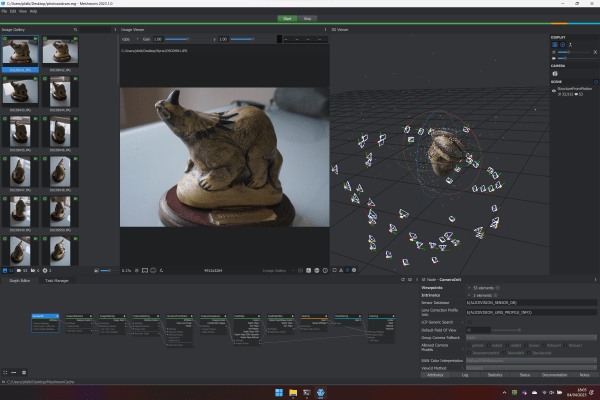
[Photogrammetry] Meshroom 2023.1 released
I've had a keen eye on Alicevision Meshroom since it's first major release back in... 2018? Development of the open source photogrammetry software has felt slow for the past few years, but just this week a new release was pushed out, 2023.1.0. Here's the official new feature list: Release Notes Summary Major improvements of the... Continue Reading →
A.I. (well, machine learning) and Dinosaur tracks
It's a while since I've posted about new papers, so I'm going to have a series of posts catching up on 2022's papers. First up is Jens Lallensack's cool paper in Interface about using AI and machine learning to distinguish between theropod and ornithopod tracks. For those unfamiliar, ornithopod tracks and theropod tracks are both... Continue Reading →
I’m A Reality Capture Convert.
Since I first started getting into Photogrammetry in a serious way, with my 2012 paper on using Bundler and PMVS, and throughout much of this blog’s life, I’ve been a massive proponent of free and open-source photogrammetry software. For years I used COLMAP, and then Meshroom. The latter was particularly good, offering a full pipeline... Continue Reading →
Neural Radiance Fields (NERF), and Instant-ngp – Future of photogrammetry?
I’ve been testing out instant-ngp recently, it’s an open-source software from Nvidia that generates neural radiance fields. That’s a 3D representation of an object that is fundamentally different from the points or verticies and faces we may be used to. Rather than representing an object through 3D coordinates, connections between them, and colours (i.e. vertices... Continue Reading →
Free photogrammetry software review: 2017
Given how insanely popular my 'trying photogrammetry software' series has been this year, I thought I'd round up what I've tried, what's worked well, and what hasn't. Obviously I gave each piece of software in my blog posts a go with a standard dataset. That photo set was not ideal - it includes photos taken... Continue Reading →
Automating free photogrammetry: Scripts I use
[updated 17/12/17 to get rid of unnecessary meshlab portion] [updated 01/04/18 - Updated scripts for version 3.4+ of COLMAP] In a vain attempt to be useful, I want to share the script I'm currently using to automate my photogrammetry workflow. I'm using COLMAP in conjunction with openMVS on Windows 10 at the moment, and I... Continue Reading →
I really dislike rotation maths!
For the last couple of days and nights, I've been doing my best to try and get my Maya scripts working to convert XROMM animations into input files for LIGGGHTS. I've previously done this for my paper with Stephen Gatesy, 'The Birth of a Dinosaur Track', but that was a) quite a while ago now,... Continue Reading →