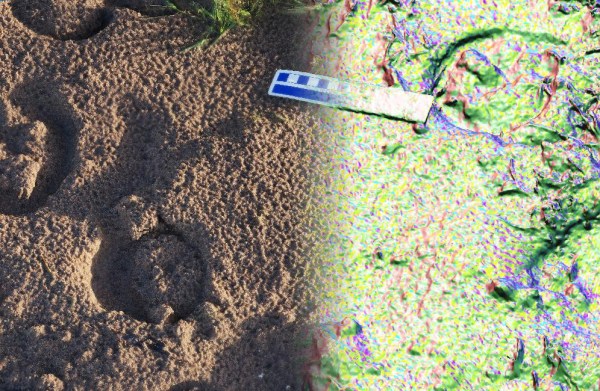
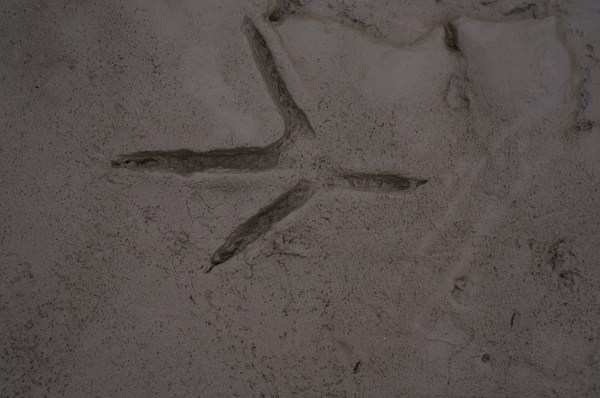
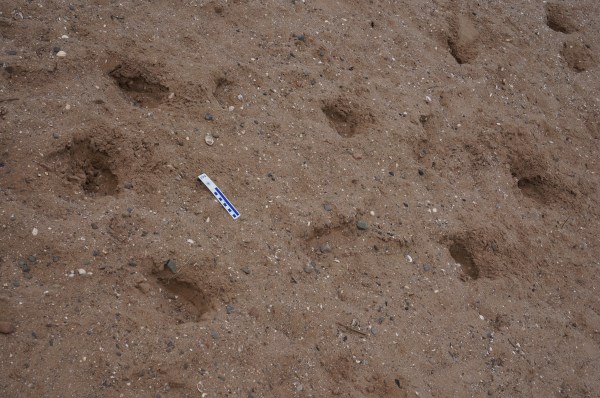
New data uploaded - Heron tracks in mud.
News/Blog
A visit to Denmark and Digitized Crocodile tracks
Last month I was fortunate to head over to Denmark and visit my friend and colleague Jesper Milàn at Geomuseum Faxe. We’ve worked together in the recent past (we have a chapter together in the forthcoming Dinosaur Tracks: Next Steps) but aside from a few conferences, we’ve never actually sat down in the same room to... Continue Reading →
New data uploaded – Horse trampled beach
Just a quick post to say that I've added a new data set to the Neoichnology resources page. It's an interesting [to me at least] area of beach sand trampled by horses (I think 2-3, but didn't see the tracks being made), heading in two directions. I recorded it for two reasons: The first is... Continue Reading →
Why Windows 8.1 and Onedrive are awesome (and Windows 10 is RUBBISH)
My extolling the wonders for productivity given by windows 8.1 and Onedrive, and my disappointment with Windows 10
SVPCA and the energising power of academic meetings
I'm back from SVPCA and after seeing all the active research, feel I can finish all my projects too... Except....
Sharing vs Presenting digital data -or- Please don’t use 3D PDFs; just upload obj/ply
This post is as much about initiating discussion as it is about my own thoughts on the matter, so feel free to comment away, here, or twitter, or google+ or wherever – I’m interested in thoughts and perspectives. So… 3D PDFs. They seem like a really good idea right? You can encapsulate 3D information to... Continue Reading →
Ugh!… Being useful? This is not what I signed up for!
As a palaeontologist, sometimes it can be difficult to justify what you do to the people down the local pub. From personal experience, I’ve learnt that when surrounded by a teacher, plumber, mechanic and farmer, announcing that the EU just gave you a substantial pot of money to look at 200 million year old dinosaur... Continue Reading →
I'm featured on May's Palaeocast. Go have a listen.
Listen to me on Palaeocast
(This guide was actually written 25/5/13, but should still be applicable. PDF here) This guide will hopefully provide a quick start to processing CT data and exporting models using 3D slicer (http://download.slicer.org/). The documentation available for Slicer is pretty fragmented and/or out of date (referring to considerably older versions), so this guide is based on... Continue Reading →
A rough guide to getting models out of CT scans using 3D Slicer (v4)
The Historical Photogrammetry Challenge – over to you!
In 2014, colleagues and I published a photogrammetric reconstruction of the Paluxy River dinosaur ‘chase sequence,’ as generated from photographs taken before and during its excavation in 1940. (Blog post here). Photogrammetry has become pretty common now; commercial and open source programs are widely being used by all kinds of people, including palaeontologists, and there are... Continue Reading →